

Lumenloop Report Warns MEES Retrofit Push Could Add to UK’s 5.2m-a-Year Lighting Waste Problem
New report says proposed EPC B requirements for larger rented commercial buildings should cut energy use without turning serviceable luminaires into avoidable waste
London, July 01, 2026 (GLOBE NEWSWIRE) -- Commercial lighting manufacturer Lumenloop has published an EPC B retrofit waste risk report warning that EPC-led retrofit work in England and Wales must not turn an existing lighting waste problem into a larger one. The warning follows the Government's June 2026 non-domestic MEES update, which proposes EPC B from 2031 for private rented non-domestic buildings over 1,000 sq m in England and Wales, where cost-effective. Recolight estimates around 100,000 luminaires are already removed from UK buildings every week, equivalent to about 5.2 million fittings a year when annualised by Lumenloop. Lumenloop says retrofit projects should check repair, reuse and modular upgrade options before strip-out turns an energy-saving job into avoidable waste.
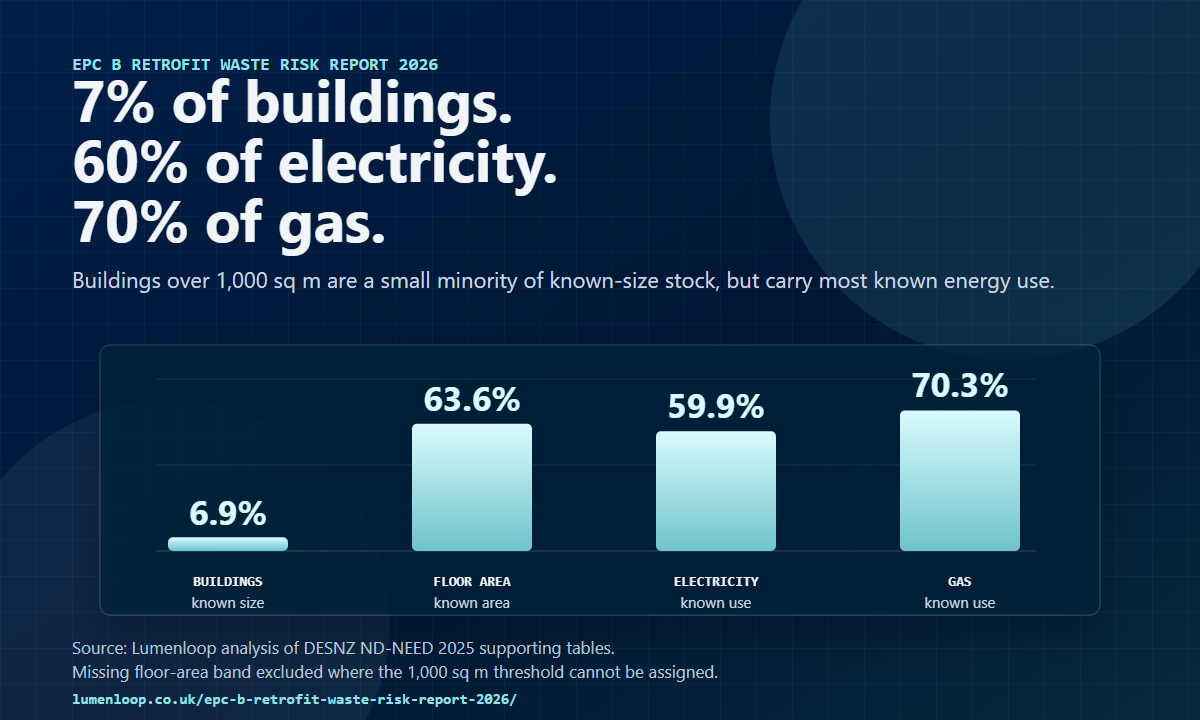
Chart from Lumenloop's EPC B retrofit waste risk report showing buildings over 1,000 sq m account for 6.9% of known-size non-domestic buildings, 59.9% of known electricity use and 70.3% of known gas use. Credit: Lumenloop.
The EPC B retrofit waste risk report brings together DESNZ ND-NEED 2025 supporting tables, GOV.UK Energy Performance of Buildings Certificates data and Recolight sector evidence. Lumenloop's analysis finds that buildings over 1,000 sq m make up only 6.9% of known-size non-domestic buildings, but account for 59.9% of known electricity use and 70.3% of known gas use.
The current legal minimum for privately rented non-domestic buildings in England and Wales remains EPC E unless a valid exemption applies. The proposed EPC B direction from 2031 still requires secondary legislation, so the report treats the policy as a planning signal rather than live law.
"EPC B is supposed to cut waste from buildings, not create a new waste mountain above the ceiling grid," said Paul Simmons, Commercial Director at Lumenloop. "If a retrofit project only asks for lower watts, it can miss the bigger question: can the luminaire be kept in use, repaired or upgraded before the whole fitting is thrown away?"
Lighting is often one of the first upgrade packages considered because it is measurable, visible and relatively straightforward to procure. That also creates a specification risk: whole-fitting replacement can be agreed before the condition of the body, driver, optics, emergency function, lighting controls or reuse potential has been checked.
For that reason, Lumenloop says commercial lighting upgrades should be treated as a specification decision, not just a purchasing exercise. Landlords, estate managers, consultants and contractors should check whether existing fittings can be maintained, repaired, reused or upgraded before a whole-fitting replacement package is agreed. Lighting controls, emergency requirements and maintenance access should be reviewed at the same stage as luminaire selection, rather than added after the retrofit scope has already been priced.
The issue is especially relevant to office refurbishments and wider commercial lighting upgrade programmes, where operating hours, ceiling conditions, controls and emergency provision can all affect the final specification.
The report does not claim that every large building in the DESNZ data is privately rented, or that all EPC-led retrofit will involve LED luminaire replacement. Its narrower point is that commercial lighting specifications need an early circularity check before strip-out decisions are made.
Report figures:
6.9% - share of known-size non-domestic buildings above 1,000 sq m.
59.9% - known electricity use attributed to buildings above 1,000 sq m.
70.3% - known gas use attributed to buildings above 1,000 sq m.
100,000/week - Recolight estimate for luminaires removed from UK buildings.
5.2m/year - annualised by Lumenloop from the Recolight weekly removal estimate.
Lumenloop says every EPC-led lighting upgrade project should ask five questions before strip-out: can the fitting be retained, can the driver be replaced, can the light engine be upgraded, can lighting controls or emergency functions be added, and is there a reuse option for serviceable equipment?
The full report includes charts, regional EPC certificate rankings and source notes for journalists, specifiers and building-services teams covering EPC policy, LED luminaire replacement, reuse options and lighting circularity.
Notes to editors
- The current minimum energy efficiency standard for privately rented non-domestic buildings in England and Wales remains EPC E unless a valid exemption applies.
- The proposed EPC B trajectory from 2031 has been set out in government policy material, but still requires secondary legislation.
- The Lumenloop report combines the 1,000-5,000 sq m and over 5,000 sq m floor-area bands in DESNZ ND-NEED 2025 supporting tables.
- Recolight's 100,000 luminaires-per-week figure is treated as sector evidence, not as an official national statistic.
About Lumenloop
Lumenloop is a UK commercial lighting manufacturer and supplier of built-to-order LED luminaires for office lighting, retail, hospitality, education and refurbishment projects. The company supports project-configured product selection across output, optics, lighting controls, emergency options, mounting and finish requirements.
ENDS
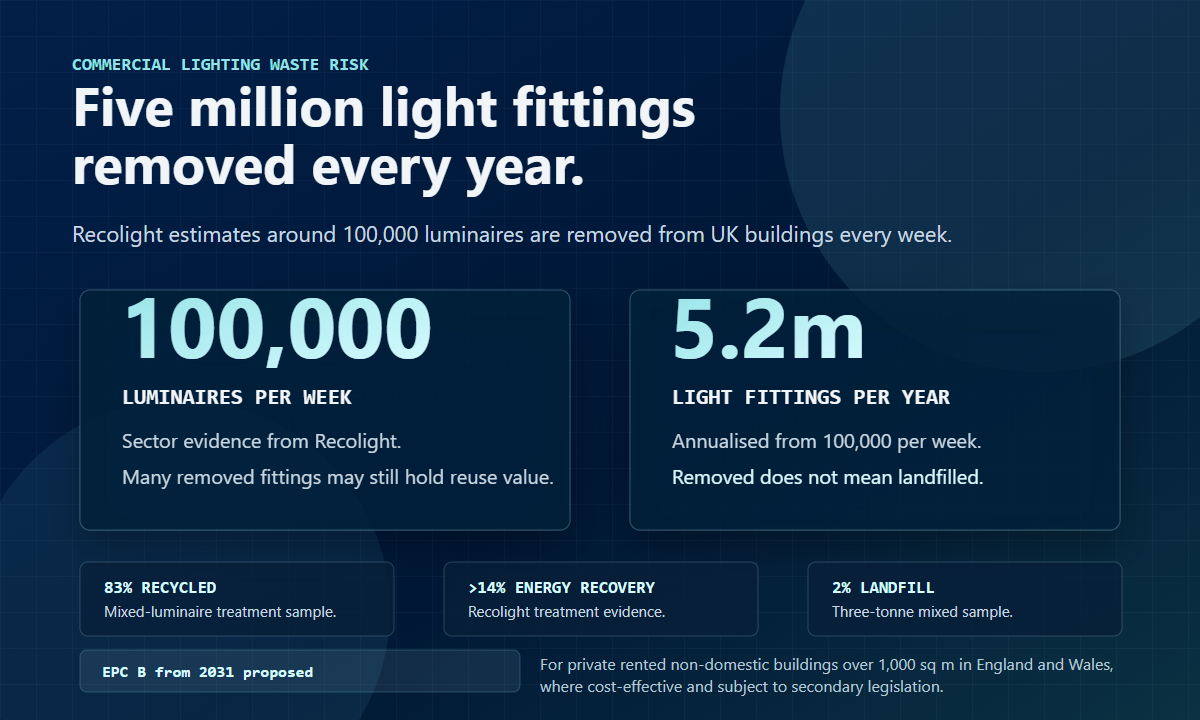
Lumenloop data card annualising Recolight evidence of around 100,000 luminaires removed from UK buildings each week to about 5.2 million fittings per year. Credit: Lumenloop.
Press Inquiries
Paul Simmons
Commercial Director, Lumenloop Ltd
info@lumenloop.co.uk
02045 721 554
https://lumenloop.co.uk
4th Floor, Silverstream House
45 Fitzroy Street, Fitzrovia
London W1T 6EB
United Kingdom


Legal Disclaimer:
EIN Presswire provides this news content "as is" without warranty of any kind. We do not accept any responsibility or liability for the accuracy, content, images, videos, licenses, completeness, legality, or reliability of the information contained in this article. If you have any complaints or copyright issues related to this article, kindly contact the author above.
